











Türkiye is a G20 member and a strategic location bridging Europe and Asia.Its GDP is around USD 1.1–1.3T. Türkiye’s economy is led by the automotive, machinery, and home appliances industries. Part of the country's national strategy is focused on increasing the domestic share of high-tech exports like defense and aerospace.
Before expanding into Türkiye, you’ll need to understand contracts, taxes, wages, benefits, and other employment laws. Our guide will tell you everything you need to know about hiring in Türkiye.
What to know before hiring in Türkiye
If you’re expanding your business into Türkiye for the first time, there are legal requirements to be aware of. These norms and laws influence hiring practices in Türkiye and many aspects of the employer-employee relationship, including compensation and benefits.
G-P Gia™, our AI-powered global HR agent, can answer your toughest compliance questions across 50 countries — including Türkiye — and all 50 U.S. states. Reduce your reliance on outside counsel and cut the time and cost of compliance by up to 95% with Gia.
Here are five things to know about hiring in Türkiye.
1. Industries in Türkiye
Türkiye's economy relies heavily on its manufacturing sector, driving over 90% of all exports. The automotive industry is the largest single export sector, sending many goods to the EU. The country's economic plan is focused on increasing domestic high-tech exports and reducing reliance on international imports in key areas.
Defense and aerospace is a fast-growing sector, having successfully developed and exported advanced technology like UAVs, the KAAN fighter jet, missiles, and air defense systems. This sector aims to create a cutting-edge technology export ecosystem.
2. Payroll taxes in Türkiye
Türkiye has a progressive income tax system. Residents are taxed on worldwide income. Non-residents are taxed only on Turkish-sourced income. Income tax brackets are:
-
Up to TRY 158,000: 15%
-
TRY 158,001 to 330,000: 20%
-
TRY 330,001 to 1,200,000: 27%
-
TRY 1,200,001 to 4,300,000: 35%
-
Above TRY 4,300,000: 40%
The employer’s share is 22.5% (20.5% for social security and 2% for unemployment insurance). The employee’s share is 15% (14% for social security and 1% for unemployment insurance). After deductions, the average employee takes home around 70% of their gross earnings.
3. Working hours and time off in Türkiye
The workweek is a maximum of 45 hours. Employees can work no more than 11 hours a day and need to have a 24-hour rest period during the workweek. To work more than 45 hours per week, an employee has to give consent in writing.
Türkiye allows up to 270 hours of overtime a year. If an employee’s working week is less than 45 hours, overtime pay is 1.25 times their regular rate. If they work more than 45 hours, they’ll get their pay at 1.5 times their regular rate.
The employment law in Türkiye has built-in rest periods throughout the working day. Employees get one 15-minute break after working four hours. They get a 30-minute break if they work 7.5 hours. If their workday is longer than 7.5 hours, they get a one-hour break.
Employees get a minimum of 14 days of paid time off after one year of employment. Once an employee has been with a company for five years, they get 20 days of paid time off. After 15 years, they get a minimum of 26 days of paid time off.
These paid days are counted separately from time off for national holidays. Türkiye observes the following holidays:
-
New Year’s Day
-
National Sovereignty and Children’s Day
-
Labor Day
-
Youth and Sports Day
-
Democracy and Freedom Day
-
Victory Day
-
Republic Day
-
Ramadan and Eid Holidays
Top hiring hubs in Türkiye
Some cities in Türkiye are known for particular industries. Knowing what each region has to offer allows you to focus your hiring efforts in the right place and fill roles faster.
The top talent hubs in Türkiye are:
-
Istanbul is the country’s largest city and top economic hub. The city is seen as a bridge between Asia and Europe. Istanbul generated 30.4% of Türkiye's GDP (2023).
-
Ankara is the capital city. Ankara is the center for Türkiye's defense and aerospace industries. It attracts specialized talent for R&D, engineering, and software development for national projects such as the KAAN fighter jet and various drone programs.
-
Izmir is a strategic port gateway on the Aegean Sea. The region's main talent concentration is in maritime logistics, import/export operations, and supply chain management.
-
Bursa is known as the Detroit of Türkiye. The city’s economy is dominated by high-volume, export-oriented manufacturing.
-
Kocaeli is an industrial and manufacturing region close to Istanbul. Key sectors include automotive parts, petrochemicals, metal, and machinery. It hosts facilities for companies like Ford Otosan.
Key industries in Türkiye
Understanding Türkiye’s top industries allows you to benchmark salaries and benefits. You can use this insight to make smart choices about where to invest and grow your talent pool.
The top industries in Türkiye include:
-
Manufacturing is the main driver of Türkiye's exports. It consistently accounts for over 90% of total exports. This sector has high demand for specialized engineering, production management, and skilled technical talent.
-
Automotive is Türkiye's largest single exporting sector, valued at over USD 32.44B. International automakers like Ford, Toyota, and Fiat have large production facilities that focus on the EU market. Türkiye offers skilled talent in mechatronics, logistics, and quality control.
-
Information and communication technologies (ICT) is one of Türkiye's fastest-growing and a national priority for digital transformation. The sector employs over 246,000 professionals. 70% of the workforce is younger than 35.
-
Logistics and transportation is valued at over USD 100B. The government aims to build 8,200 kilometers of high-speed rail line by 2028.
-
Agriculture: Türkiye is a global leader in the production and export of hazelnuts, cherries, figs, and apricots.
The cost of hiring an employee in Türkiye
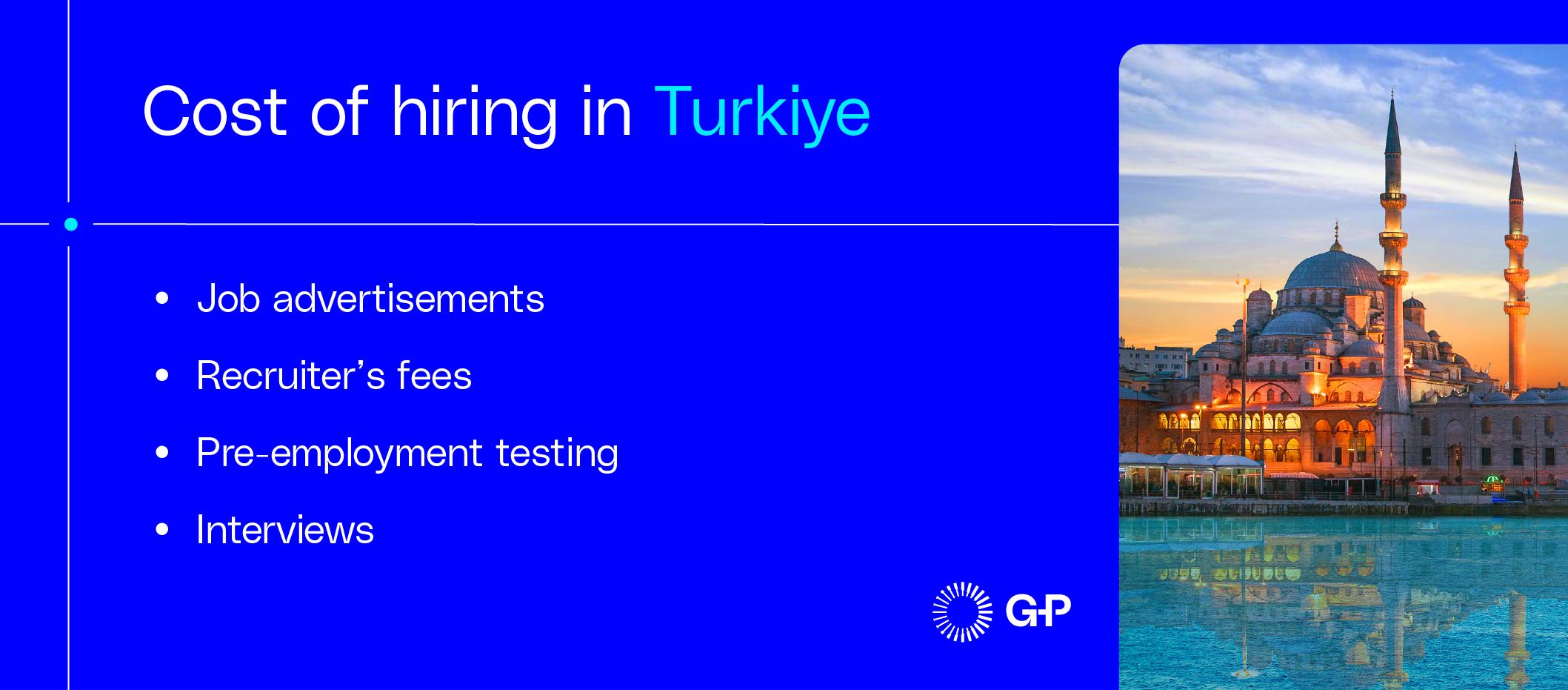
Whether you’re hiring one employee or an entire team in Türkiye, expenses are inevitable. Budget for the following:
-
Setting up an entity (unless you partner with an employer of record)
-
Advertising job positions
-
Paying referral bonuses to employees with connections in Türkiye
-
Paying an in-house hiring committee
-
Traveling to and from Türkiye, including hotel stays, meals, and transportation
-
Partnering with a translator to draft documents or facilitate conversations (if applicable)
-
Using a background check service for screening candidates
-
Drafting compliant employment contracts, legal review, and consultation with HR and legal experts
-
Costs for providing computers, phones, and software licenses
-
Onboarding materials and initial training
-
Costs for maintaining required tax and payroll records and documentation
According to G-P Verified Sources from Gia, the employer burden rate in Türkiye, which includes costs triggered on top of salaries, is about 22.5%, excluding accident insurance that can vary.
What does a company need to hire employees in Türkiye?
Make sure you cover these essentials before expanding your team in Türkiye:
-
Establish a legal entity in Türkiye, such as a subsidiary or branch office.
-
Register with the Turkish tax authorities to get a tax identification number.
-
Register with the social security institution (SGK) for social security contributions.
-
Open a local bank account to process payroll and payments.
-
Comply with local employment laws, including preparing compliant employment contracts, adhering to minimum wage requirements, and providing benefits.
Setting up a subsidiary in Türkiye can take weeks or months. Use G-P EOR to hire full-time employees in Türkiye without setting up your own entity. Build your team at a lower cost and with peace of mind that you’re doing so compliantly.
The steps to hiring employees in Türkiye
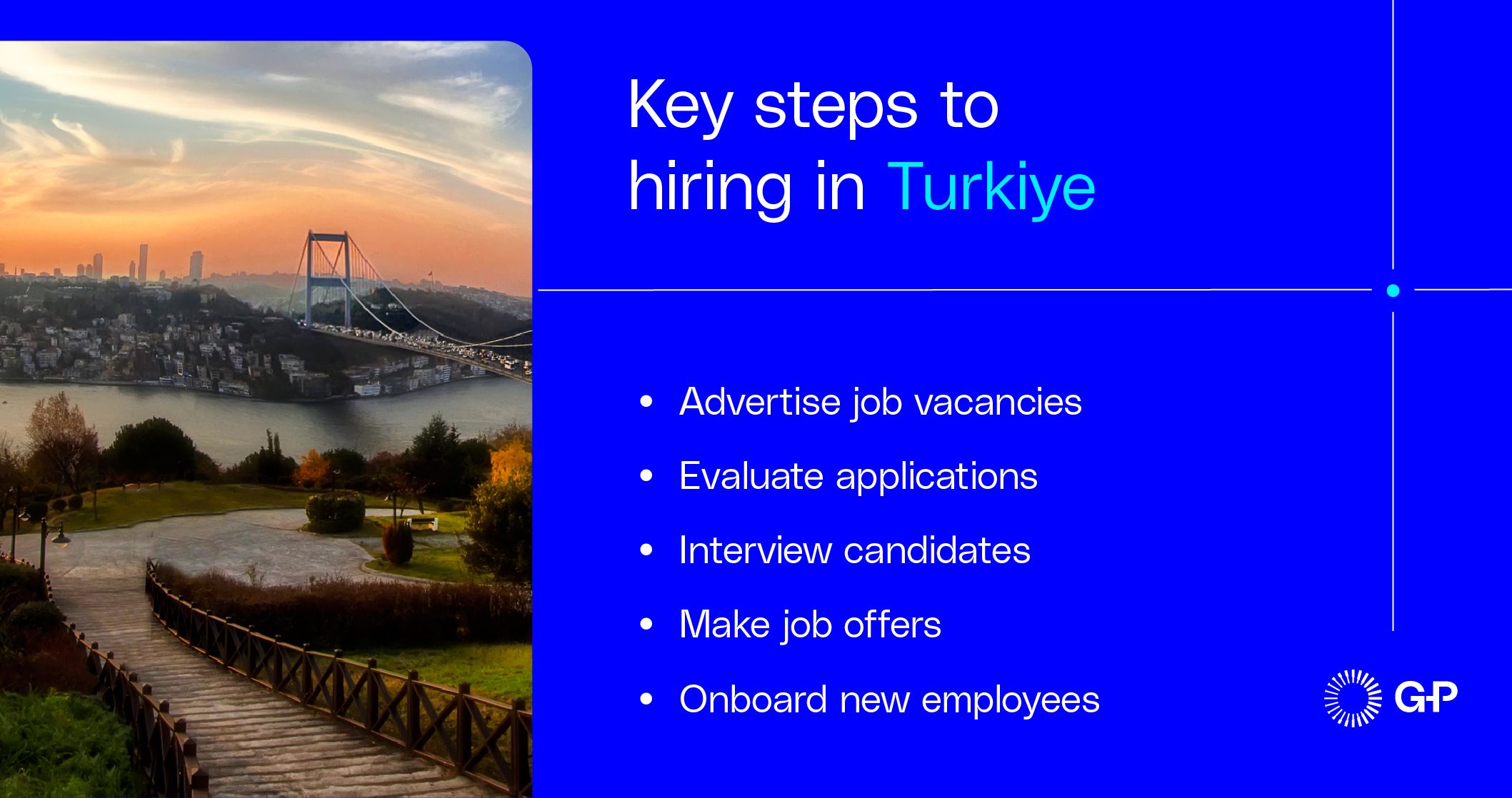
The hiring process in Türkiye is similar to the one you’re likely familiar with in your own country. The hiring process follows five basic steps: advertising the job, evaluating applications, interviewing candidates, sending job offers, and onboarding new employees.
1. Advertising job vacancies in Türkiye
Prepare a clear job description that outlines responsibilities, qualifications, and compensation. Post the vacancy on local job boards.
Kariyer, isinolsun, Secretcv, and LinkedIn are popular job sites in Türkiye.
2. Evaluating job applications in Türkiye
Screen CVs and application forms to shortlist suitable candidates.
3. Interviewing candidates in Türkiye
Interview shortlisted candidates. If needed, administer tests or assessments relevant to the role. Gia can help you create questions that follow anti-discrimination laws in Türkiye, so you can find the best fit for the role while complying with local regulations.
4. Making job offers in Türkiye
Choose the most suitable candidate based on their qualifications, experience, and interview performance. Draft a written employment contract in compliance with Turkish employment law. Make sure to outline terms such as job title, salary, benefits, and working hours.
5. Onboarding new employees in Türkiye
Now you can onboard new employees. Register your new hire with the SGK and tax authorities. Provide orientation, training, and necessary resources for the new employee to start their role.
If you’re working with an EOR like G-P, you won’t have to worry about the administrative burden of onboarding. We’ll streamline the process, so you can focus on training your new hire and integrating them into your company culture.
Hiring contractors in Türkiye
Working with independent contractors in Türkiye can be a cost-effective way to test the market and build a presence without the commitment of full-time employees. Contractors based in Türkiye understand local consumer behavior, rules, and business practices. They’ll be ready to start working quickly with their own equipment and established work processes.
Hiring contractors allows you to easily adjust your talent pool based on your business needs, without the complexities and costs of employment.
Before you enter an agreement with an independent contractor in Türkiye, consider the following:
1. Employees vs. independent contractors in Türkiye
It’s important to understand the difference between employees and independent contractors. Employees in Türkiye work under the employer’s direction and supervision, are integrated into the company, and get regular wages and benefits (such as paid leave, severance, and social security).
Independent contractors provide services, set their schedules, use their own equipment, and are paid per project or service. They’re responsible for their own tax and social security obligations and don’t get employee benefits. Turkish law focuses on the actual working relationship rather than contract titles.
2. Penalties for misclassification in Türkiye
Classifying someone as a contractor when they’re not can lead to severe penalties. If misclassification occurs, you’ll have to:
-
Pay back taxes and social security contributions.
-
Face fines and interest on unpaid amounts.
-
Deal with potential legal action from misclassified workers.
3. How to pay contractors in Türkiye
G-P Contractor™ takes away the messy, time-consuming process of hiring and paying international contractors. You can create and issue contracts and pay contractors with just a few clicks, all while ensuring a compliant process.
Hire employees and contractors in Türkiye with G-P
Our SaaS and AI-powered products – EOR, Contractor, and Gia – support companies as they build and manage global teams.
G-P is the recognized leader in global employment with more than a decade of experience, the largest team of HR, legal, and compliance experts, and a global proprietary knowledge base.
Make your expansion to Türkiye easier with G-P. Contact us or book a demo today.