











Czechia is a key hub for engineering and manufacturing talent. Its GDP is USD 360B. The nation’s economic foundation is built on an export-based manufacturing sector. The country is home to Škoda Auto. Before expanding into Czechia, you’ll need to understand contracts, taxes, wages, benefits, and other employment laws. Our guide will tell you everything you need to know about hiring in Czechia.
What to know before hiring in Czechia
If you’re looking to hire employees in Czechia for the first time, there are legal requirements to be aware of. These norms and laws influence hiring practices in Czechia and many aspects of the employer-employee relationship, including compensation and benefits.
G-P Gia™, our AI-powered global HR agent, can answer your toughest compliance questions across 50 countries — including Czechia — and all 50 U.S. states. Reduce your reliance on outside counsel and cut the time and cost of compliance by up to 95% with Gia.
Here are five things to know about hiring in Czechia.
1. Contracts and termination in Czechia
A written employment contract is required and has to include the type of work, place of work, and start date. Other details such as annual leave, working hours, compensation, and collective bargaining information, have to be given in the contract or in a separate document. This has to be done within seven days of the employee’s start date.
Contracts can be indefinite or fixed-term. Fixed-term contracts are limited to three years per contract. They can only be renewed twice for a total of nine years with the same employer.
Probation is four months for most employees and eight months for managers. During probation, either party can terminate the contract in writing without cause or notice.
After probation, termination is only possible for reasons specified in the labor code, with a notice period of two months. Immediate termination is only allowed for gross misconduct or if the employee is sentenced to prison for one year for an intentional crime.
2. Payroll and taxes in Czechia
Employers contribute 24.8% of gross salary to social security for pension, sickness, and state employment policy. Employers contribute 9% toward health insurance. Employees contribute 7.1% to social security (6.5% for pension, 0.6% for sickness) and 4.5% to health insurance.
Personal income tax is progressive: 15% on income up to a set threshold and 23% on income above that. The corporate income tax rate is 19%, with a 5% rate for basic investment funds. Withholding tax on dividends, royalties, and similar payments is 15% or 35%, depending on the recipient’s tax residency. Employers have to withhold and remit employee income tax, social security, and health insurance contributions every month.
3. Working hours and overtime in Czechia
The workweek is 40 hours. The maximum daily shift is 12 hours.
Overtime is allowed but it can’t exceed an average of eight hours per week over a 26-week period. This can be extended to 52 weeks by collective agreement. Employees get 125% of their average earnings for overtime hours, or compensatory time off.
Night and weekend work require a minimum 10% premium. Employees get:
-
11 hours of rest between shifts
-
A 30-minute break after six hours
-
35 hours of uninterrupted weekly rest
4. Leave and benefits in Czechia
Employees get four weeks of paid annual leave. Some workers, such as public sector employees, get five weeks.
Sick pay is 60% of average earnings for the first 14 days of illness or injury. This is paid by the employer. After this, social security pays.
Maternity leave is 28 weeks (or 37 weeks for multiple births). Either parent can take up to three years of parental leave to care for a child.
Bonuses and premiums are common but not guaranteed by law.
Czechia has a universal healthcare system funded by contributions totaling 13.5% of gross salary (9% paid by the employer, 4.5% by the employee). Healthcare is generally free at the point of use, though specialized services can have fees.
5. Job market and workforce education in Czechia
Czechia has one of the lowest unemployment rates in the EU. The workforce is highly educated, with a literacy rate above 99%. A high proportion of residents have a secondary or postsecondary degrees, ranking among the top in OECD and partner countries.
Top hiring hubs in Czechia
Some cities in Czechia are known for particular industries. Knowing what each region has to offer allows you to focus your hiring efforts in the right place and fill roles faster.
The top talent hubs in Czechia are:
-
Prague is the capital and largest city. Prague is the top hub for finance, technology, business services, and global companies. The city's tech talent is concentrated in software development, cybersecurity, and fintech.
-
Brno is recognized as Czechia's second tech hub and a leading R&D center. Brno’s main sectors are advanced IT and software development, life sciences, and engineering. The city’s 10 universities have 65,000 students.
-
Ostrava is an industrial city. It was a coal-mining and metal powerhouse. The city is changing to a knowledge-based economy, such as business services and IT.
-
Plzeň (Pilsen) is known for engineering and manufacturing. The city’s industry grew from the Škoda Works and now focuses on heavy machinery, train equipment, and car components. Its location near Germany makes it a key part of the automotive supply chain.
-
Liberec is a regional center for the automotive supply chain and engineering. Its old textile industry has been replaced by modern manufacturing and focuses on car components and mechanical engineering.
Key industries in Czechia
Understanding Czechia’s top industries allows you to benchmark salaries and benefits. You can use this insight to make smart choices about where to invest and grow your talent pool.
The top industries in Czechia include:
-
IT and software development: Czechia is a regional leader in IT, with a strong pool of software engineers, developers, and cybersecurity experts. The sector benefits from strong academic institutions and relatively lower labor costs compared to Western Europe.
-
Automotive: The country is a hub for automotive manufacturing, engineering, and related supply chains. The industry is anchored by original equipment manufacturers (OEMs) like Škoda Auto, Hyundai Motor Manufacturing Czech, and Toyota Motor Manufacturing. Czechia has a strong export link to Germany.
-
Business process outsourcing (BPO) and shared services: Many multinational companies have set up shared service centers in Prague and Brno. Services focus on high-value tasks, including finance and accounting outsourcing (FAO), IT support, data analytics, and multilingual customer service in French, German, and English.
-
Manufacturing and industrial production: Czechia is ranked as one of the most industrialized countries in the EU. The country is in the top 15 countries for machine tools production. Around 85% of manufactured products are exported.
-
Pharmaceuticals and life sciences: There’s a growing sector for pharmaceuticals, biotechnology, and medical research in the country. Czechia has 400 biotech-related entities and employs over 22,000 professionals.
The cost of hiring an employee in Czechia
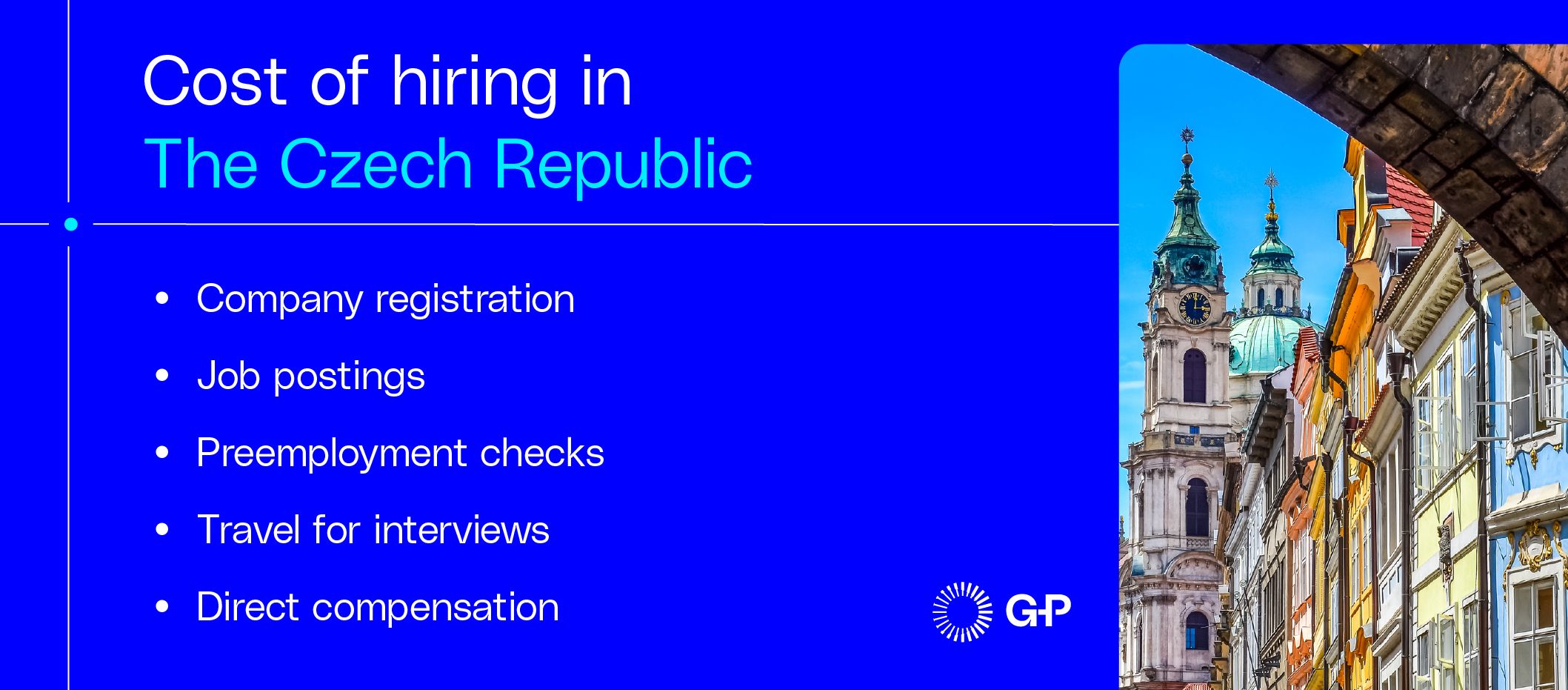
Whether you’re hiring one employee or an entire team in Czechia, expenses are inevitable. Budget for the following:
-
Setting up an entity (unless you partner with an employer of record)
-
Advertising job positions
-
Paying referral bonuses to employees with connections in Czechia
-
Paying an in-house hiring committee
-
Traveling to and from Czechia, including hotel stays, meals, and transportation
-
Partnering with a translator to draft documents or facilitate conversations (if applicable)
-
Using a background check service for screening candidates
-
Drafting compliant employment contracts, legal review, and consultation with HR and legal experts
-
Costs for providing computers, phones, and software licenses
-
Onboarding materials and initial training
-
Costs for maintaining required tax and payroll records and documentation
According to G-P Verified Sources from Gia, the employer burden rate in Czechia, which includes costs triggered on top of salaries, is about 33.8%, excluding accident insurance that can vary.
Make sure you cover these essentials before expanding your team in Czechia:
-
Register a local company (such as an s.r.o. or branch office) with the Czech commercial register .
-
Register with the Czech tax authorities for corporate and payroll tax purposes.
-
Enroll the company and employees with the Czech social security administration (ČSSZ) and a health insurance provider.
-
Open a local bank account.
-
Draft written employment contracts in Czech, specifying all required terms and conditions.
Setting up a subsidiary in Czechia can take weeks or months. Use G-P EOR to hire full-time employees in Czechia without setting up your own entity. Build your team at a lower cost and with peace of mind that you’re doing so compliantly.
The steps to hiring employees in Czechia
The hiring process in Czechia is similar to the one you’re likely familiar with in your own country. The hiring process follows five basic steps: advertising the job, evaluating applications, interviewing candidates, sending job offers, and onboarding new employees.
1. Advertising job vacancies in Czechia
Prepare a clear job description that outlines the successful candidates’ responsibilities, qualifications, and compensation. Post the job. Prace, JenPráce, Profesia, Jooble, and LinkedIn are popular job boards in Czechia.
2. Evaluating job applications in Czechia
Screen CVs and cover letters to shortlist candidates who meet your requirements.
3. Interviewing candidates in Czechia
Conduct your initial interviews over the phone, video, or in-person. Gia can help you create questions that follow anti-discrimination laws in Czechia, so you can find the best fit for the role while complying with local regulations.
The next step is to verify employment history, education, and conduct background checks if required.
4. Making job offers in Czechia
Prepare a compliant written employment contract in Czech. Clearly state the salary, benefits, job duties, and termination terms.
5. Onboarding new employees in Czechia
Now you can onboard new employees. Register your new hire with social security and a health insurance provider. Set up payroll, provide orientation, and make sure the employee understands your company policies. Keep accurate employment records and ensure ongoing compliance with Czech employment laws.
If you’re working with an EOR like G-P, you won’t have to worry about the administrative burden of onboarding. We’ll streamline the process, so you can focus on training your new hire and integrating them into your company culture.
Hiring contractors in Czechia
Working with independent contractors in Czechia can be a cost-effective way to test the market and build a presence without the commitment of full-time employees. Contractors based in Czechia understand local consumer behavior, rules, and business practices. They’ll be ready to start working quickly with their own equipment and established work processes.
Hiring contractors allows you to easily adjust your talent pool based on your business needs, without the complexities and costs of employment.
Before you enter an agreement with an independent contractor in Czechia, consider the following:
1. Employees vs. independent contractors in Czechia
It’s important to understand the difference between employees and independent contractors. In Czechia, employers hire employees to do work and, in return, pay them a regular salary and benefits. Independent contractors provide services. Unlike employees, contractors don’t work under close supervision, don’t use company equipment, and aren’t economically dependent on one client.
2. Penalties for misclassification in Czechia
Czech law focuses on the working relationship, not just the contract’s wording. If an employee is treated like a contractor, this can be considered “disguised employment” (the Švarc system). Classifying someone as a contractor when they’re not can lead to severe penalties.
If misclassification occurs, you’ll have to:
-
Face fines of up to CZK 10M (EUR 400,000).
-
Pay retroactive social security and health insurance contributions, as well as any unpaid wages, overtime, and benefits.
-
Face liabilities for unpaid payroll taxes and related penalties.
3. How to pay contractors in Czechia
G-P Contractor™ takes away the messy, time-consuming process of hiring and paying international contractors. You can create and issue contracts and pay contractors with just a few clicks, all while ensuring a compliant process.
Hire employees and contractors in Czechia with G-P
Our SaaS and AI-powered products – EOR, Contractor, and Gia – support companies as they build and manage global teams.
G-P is the recognized leader in global employment with more than a decade of experience, the largest team of HR, legal, and compliance experts, and a global proprietary knowledge base.
Make your expansion to Czechia easier with G-P. Contact us or book a demo today.